Proof of exploitability, without the exfiltration.
Scanners flag maybes. A manual test is a slow snapshot. Cloud tools run your topology on someone else's servers. And on an industrial network the tools that would test it properly are the ones nobody is allowed to point at it. Nexich proves the real attack path, on demand, at machine scale, and on a local model entirely inside your network.
Nothing you own ever leaves your network.
A red-team tool sees the most sensitive things you have: your topology, your credentials, your unpatched paths. Sending that off-site to be processed is the wrong direction. Nexich keeps the reasoning, the exploits, and the evidence on your own metal. Zero egress is fully supported, not a paid upgrade.
Your map, shipped off-site.
Cloud autonomous tools process your network in their infrastructure. Your asset inventory, looted credentials, and findings leave the perimeter to be stored and analyzed somewhere you do not control. For sensitive infrastructure, that trade never made sense.
> engagement   internal /24
> hosts mapped  live inventory, on-box
> loot          credentials, held on-box
> ai reasoning  local, in-perimeter
> egress        0 bytes off-network
> sealed · nothing left the wire
Plants get the safest possible assessment, and learn nothing from it.
The reason is not that nobody tried. It is that the two honest options are both bad, and most sites pick the second.
Point a real red team at the plant.
It finds real paths, and it is also the reason nobody does it. A tool tuned for a corporate estate scans harder when a host goes quiet, retries a failed login, enumerates because enumeration looks free, and treats the most fragile device as the most interesting one. Every one of those reflexes is correct on an office network and is an incident on a control network, where a controller has a handful of connection slots and a documented threshold above which it stops processing traffic to protect its scan cycle.
Send someone to write down what is there.
A port list, an asset inventory and a report that never touched anything. It is safe, it is what most industrial assessments actually are, and it answers none of the questions that matter: whether the engineering workstation is reachable from the office network, whether the DMZ terminates a protocol or merely forwards it, whether the controller on line 1 is running with its protection level off.
Read the plant the way a commissioning engineer would.
Nexich earns its findings from what a device volunteers about itself. A controller reports its own protection level. An outstation answers without a Secure Authentication challenge. An identity reply names a device profile. A Purdue crossing is proven by a connection that is then closed. None of that requires writing to a process, and none of it is a guess: the controller said it.
A finding is a rumor. A shell is the truth.
Detection engines infer risk from versions and banners, then hand you a backlog of unproven criticals. Nexich pulls the trigger. It chains and detonates findings into a captured session, a dumped database, an owned domain. Proof or it is not reported as a trusted finding, so your team triages exploited facts instead of maybes.
In AI modes, a finding becomes a trusted result only once it is reproduced.
Nexich captures a real session on a real host, then traces the exact path from that foothold to the assets that matter. You see what an attacker would reach and precisely how they would get there, scored and repeatable.
A backlog of maybes.
Scanners rank criticals by inference. Your team spends its hours deciding which ones are even real.
Leave your network while the path is proven, air-gapped on a local model. The synthesized exploit detonates inside an isolated sandbox, not on your production hosts.
The real kill chain.
A to B to C, with looted credentials replaying natively across services (SSH, SMB, databases, web, RDP) from host to host. Each carries immutable provenance (origin operation, host, finding) and persists across operations, so every hop is evidenced and scored.
Verify a fix the moment it ships.
Reproduce a proven web or network path in one click. Confirm the door is closed with the same evidence that showed it open, not a fresh round of human hours.
One operator's reach, every week of the year.
A manual test is a skilled snapshot: accurate the day it is written, stale a week later, and bounded by the hours a human could bill. Nexich runs the same chain autonomously, so validation is a standing capability rather than an annual event. It covers the fifty-one weeks between engagements at machine scale.
Full TCP and UDP coverage in autonomous modes, every service that answers, including the industrial ports a top-1000 list never contains.
Protocol-aware and port-agnostic for web and banner-leaking services. Nexich maps the network the way an operator would, quietly, from IT to OT (Modbus, S7comm, BACnet, DNP3), without a human choosing where to look first.
Human-hours, once a year.
Depth capped by the budget for billable time, and a report that ages the moment it lands.
When no exploit exists, it writes one.
Nexich authors a custom exploit, detonates it in a hardened, isolated sandbox, and captures the foothold you can reproduce.
A repeatable mode for evidence.
Run the same path the same way when you need results that hold up in an audit.
It thinks like a red teamer and moves like software.
Point Nexich at a network and it reasons about the terrain, then drives each finding forward until it holds real access. No queue, no scheduling, no waiting for the next window.
Your operation. Your model.
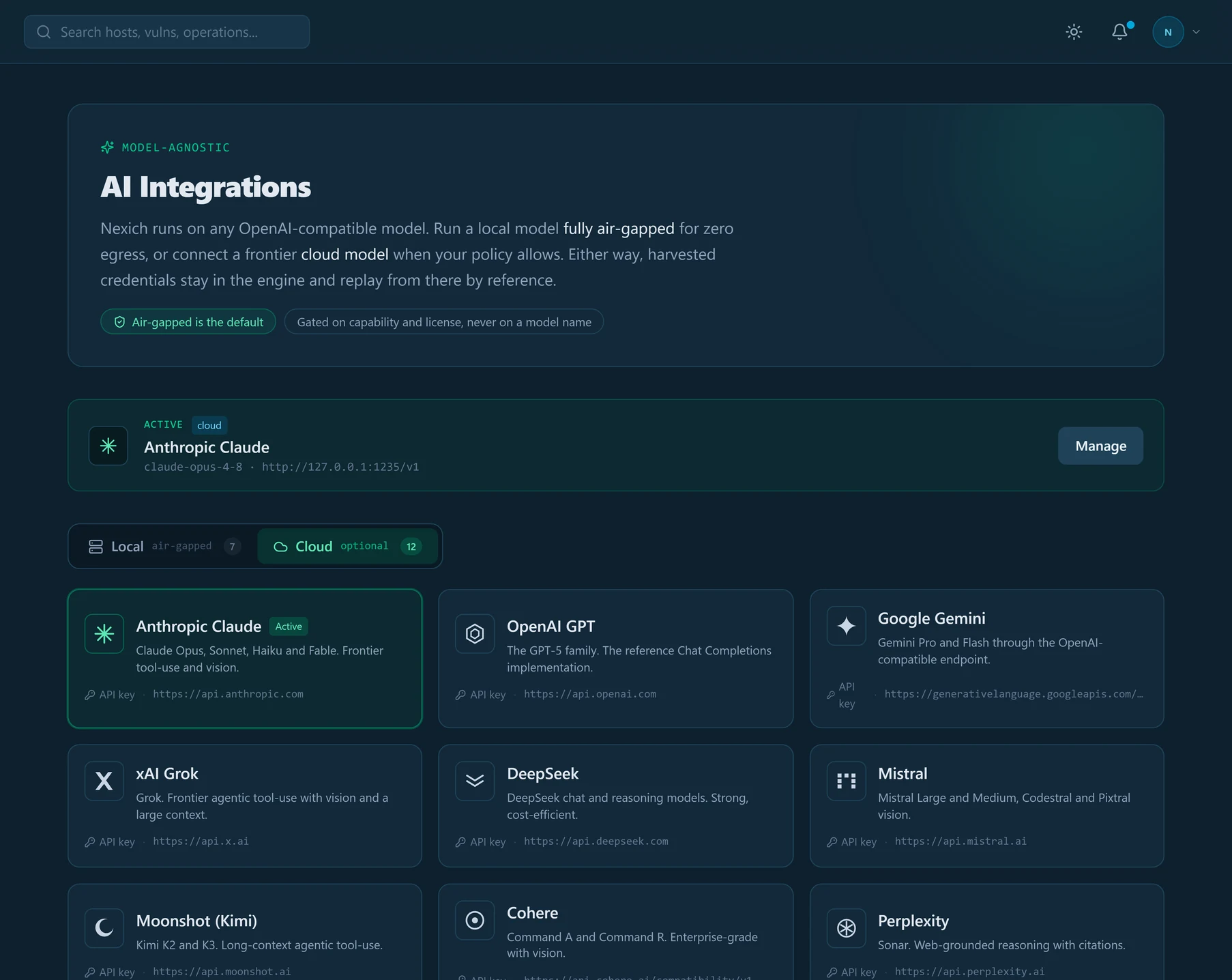
Nexich runs on any OpenAI-compatible model. Keep it fully air-gapped on a local model for zero egress, or connect a frontier cloud model when your policy allows. Either way the harvested credentials stay in the engine and replay from there by reference, and a bogus-credential re-dial flags any service that accepts anything, so a real credential gate is proven rather than assumed. Access is gated on inferred model capability, not on a fixed vendor list.
Adversarial Exposure Validation, with the cloud taken out of it.
Analysts have a name for this work now. Adversarial Exposure Validation, or AEV, is defined by Gartner as technology that produces continuous, automated evidence that an attack is actually feasible against your environment and your controls. It absorbed breach and attack simulation and automated penetration testing as separate categories, and it is the validation half of Continuous Threat Exposure Management.
Nexich is a solution in that category. It is not a vendor named in anyone’s guide, and saying so costs nothing: the definition is a description of the work, not a membership list. What separates this one is delivery. AEV as it is sold today assumes a vendor cloud, so your topology, your credentials and every weakness found are processed somewhere you do not control. A defence network, a payment environment or a plant floor cannot accept that, which leaves the organisations with the most to lose without a supplier they are allowed to use. Nexich runs the entire loop, the model included, inside your perimeter.